
Why national security law is “more than the sum of its parts”: speech by Danielle Ireland-Piper
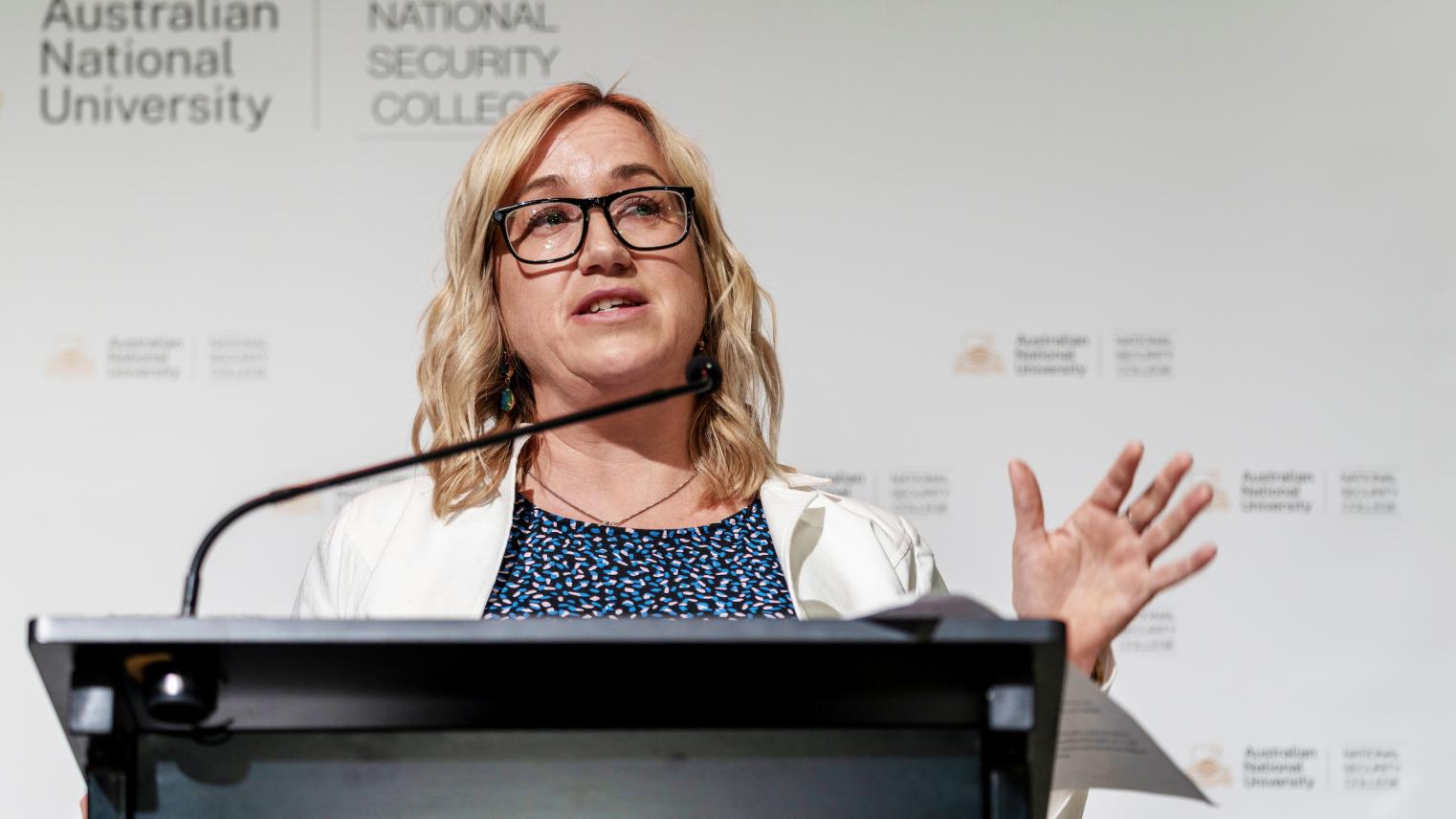
Jamie Kidston/ANU
Delivered on 27 February 2025. Check against delivery.
Thanks very much everyone for being here this evening. I’d like to echo Sally’s acknowledgement of Ngunnawal and Ngambri country and extend my own - and the panel’s - respects to elders past and present.
The notion of national security is a contested one. There are views that national security is not capable of any definitive legal definition and must change according to context – time, history. Whether or not this is true, the reality is that notions of national security are no longer politically bound to the conventional conceptual limits of militaristic threats, espionage, spies, and honeypots.
Instead, issues of national security are widely accepted as including challenges such as social cohesion, disinformation, food security, climate and natural disasters and to the unique logistical security challenges posed by human activities in cyberspace and outer space.
In short, the events of the 21st Century have shown that human security and national security are not entirely discrete fields in any practical sense (despite theoretical objections to the conflation of the two).
That is not to diminish in any way the very real risks posed by current geopolitical contexts: Russian war in Ukraine, the bloody conflict in the middle east, as well as tensions closer to home. It is more to say that traditional and non-traditional national security risks are interconnected.
As observed just last week by the ASIO Director General in the annual threat assessment:
“The most confronting thing about the new security environment – is there is no single security concern.”
He also went on to note that “The impacts of social media, mental health, the spread of misinformation and conspiracy theories, ubiquitous encryption, growing grievance and the radicalisation of minors all require whole of government, whole of community, whole of society responses.”
He also made mention of the issue of social cohesion in the face of increased instances of hate crimes describing a ‘polarised, grievance-rich environment’ in which ‘social cohesion will remain strained and we can expect spikes in communal violence’. This observation is made against a backdrop of widely reported and marked increase in hate crime incidents in Australia since October 2023. These threaten both the safety of individuals and the stability of our entire society. They must stop. When we are divided, we are more vulnerable to external threats, including foreign interference. Our first responders are diverted, and those who seek to divide us have the gate left open for them. Our cooperation, kindness and solidarity with one another is a type of defensive armour and we cannot afford to let it go. The law has a role to play in this – as we have seen in the recent passing by the government of additional criminal offences – but it is a whole of society problem first and foremost. Law is just a tool.
Successive Defence Strategic Reviews have now been unequivocal in identifying climate change as a national security issue, noting not only the impacts on human security, but that ‘the acceleration of major climate events risks overwhelming the government’s capacity to respond effectively and detracting from Defence’s primary objective of defending Australia’.
Social and economic inequality has also been identified as a threat to national security because it can disrupt national unity, quality of life and wealth distribution. Addressing non-traditional security threats like food security, environment protection, water storage, health facilities, education and equal access to justice are as important in safeguarding the people as ensuring protection from the soldiers of the enemy. Others have also noted the link between economic inequality and far right populism in a way that frames social justice as a national security issue.
Of course, there are clearly risks in making everything a national security issues – securitisation can curb civil liberties, lessen imaginations of more creative solutions, and take away from the very important core work undertaken by defence and national security agencies.
At its bare minimum, however, perhaps we can agree national security is the nation state’s right - and obligation - to keep its existence, citizens and values safe. It is a type of guardianship.
The role of law is to enable, operationalise, regulate, and sometimes to restrain the arms of guardianship.
In turn this means that national security law is inherently interdisciplinary, constituted by disciplines such as the criminal law, the constitution, questions of administrative justice, immigration, military, and telecommunications law, and . of course, inevitably intersections with human rights law .
National security also intersects with principles of international law, as we balance our need for intelligence with the sovereignty of other states and recognise, of course, the impact of global security on national security and the expanded law-making authority that membership of an international treaty can enable in the Commonwealth … as well as our obligations to both individuals and other states. Recently at a conference I heard a military officer say that international legal order is less about rules governing relationships, and more about relationships based on rules that enhance development and generate peace.
So, as you might imagine, when I went looking for a text with which to teach National Security law to a highly multidisciplinary student body in the NSC’s Master of National Security Policy, I couldn’t find a book that engaged in anything that wasn’t in a particular silo … understandably compromising breadth for depth.
But a bird's eye view is still incredibly helpful and can help manage the risk of not being able to see the forest for the trees.
So, as they say, if you want something done, do it yourself – so I approached Federation Press with the proposal and they kindly accepted.
I am grateful to Trish and Jason for trusting me with the project. I am also grateful to Professor Rory Medcalf and other colleagues at the National Security College for taking a gamble on including a lawyer in your interdisciplinary team and being so supportive of this project.
Thanks are also owed, in particular, to Olivia, Brooke, Tim for their support of this event and of the academic program in general. A particular shout out to Tanuj who patiently responded to my questions around colour schemes “is the pink on the cover too pink”.
If you’ll forgive me a momentary diversion – just briefly – you’ll see on (roman number) page 10 of the book that it is dedicated to Jack. Jack was my younger brother. He died right in the middle of this project from injuries sustained in NDIS care and – technically speaking – incurred in the course of a QLD Police operation.
This is not because he had done anything wrong, but because in QLD, police are used for mental heath call outs and Jack lived with autism, schizophrenia and PTSD. There are still three of four inquiries outstanding in relation to his death. However, the QLD Health report that my family did receive acknowledged that inadequate information sharing between QLD and NSW was a contributing factor in Jack being let down by systems that were supposed to help him.
It also speaks to the role of mental health management in a federation – something we have seen play out in security events.
It is a reminder that, invariably, the nuts, bolts and glue of organisational effectiveness invariably depend on the kinds of mundane simplicities which are too often neglected in the super-charged atmosphere of high-end deliberations.
Ironically, one of the chapters I wrote – with my colleague James Mortensen – is on the challenges a federal system poses when responding to national security threats. Decentralised power can be a wonderful thing, but sometimes our federal system allows for buck passing and disjointed responses to national security risks, as we have seen in the management of climate change, the environment, and as we saw, for better or worse, during the covid 19 pandemic.
In my view, the constitutional mechanisms for a more cooperative federalism are poorly understood and generally underutilised. We are doing better, but we can do better still. It will save lives.
How I managed to land this project in the aftermath of that while also teaching full time, I still don’t know. But I do know having brilliant authors who were reliable and professional was a significant factor. So, thanks are also owed to each of the 21 contributing authors, including some in the audience tonight – Lauren Sanders and special mention to my NSC Colleague – Dr. James Mortensen, who as a historian and a philosopher, was our token non-lawyer and did a great job of speaking across-disciplines. I was also ably assisted with finicky footnotes by research assistants Alana Bonenfant, Jacob Huth, and Andreas Berg.
I’m also pleased to say that of the 22 authors (including me), 10 were men (11 if you include Professor Rory Medcalf’s foreword) and 12 were women, so almost 50/50 gender parity.
More law is not always the answer. In fact, the general lore of more law is the law of unintended consequences, overreach, and cramming ourselves into legislative corners.
Intelligence practices often require the balancing of liberty and security – with the protection of human rights sitting on both sides of that equation. Security is not an abstract value … it is also the security of our rights and values. In Sophie Duroy’s wonderful book on intelligence and international law, she observes that National security is the means to the people’s security and not an end in itself.
We have seen this tension play out time and again: how do we balance the rights of the many with the rights of the few.
This balancing act requires flexibility and moral reasoning and this is the role law and lawyers can fill. Law also faces the challenge of keeping pace with technology – like Sisyphus and his rock. Moreover, it demands a granular understanding how these rights can be exercised and balanced in practice, in the context of a country and globe which is changing at an exponential, super-charged rate.
National Security Law is certainly more than the sum of its parts and I look forward to touching on some key issues in a discussion with a sample of the book’s authors this evening.
Tonight on stage, we have Rebecca Ananian-Welsh, Douglas Guilfoyle, Sangeetha Pillai, and Dominique Dalla-Pozza. Respectively, they are experts in the independence of the courts, international law, citizenship law, and foreign interference and espionage. We also have Lauren Sanders in the audience, who wrote on the intersection between the laws of armed conflict and national security. Fair warning I will be directing any questions on call out powers to her.
You’ll see from the chapter list that others areas covered in the book include executive power, human rights, gender, counter terrorism, cyber space, biosecurity, use of weapons, maritime law, and space law.
James Renwick KC in his very kind review of the book for the Australian Law Review has suggestions for what we might include in a future edition (watch out federation press!). He reminds us of mobilisation themed legislation in 1939 and wonders what that might look like today. I also think, in retrospect, the book should have a standalone chapter on climate, on social cohesion, as well as on the regulation of intelligence. There is also a dire need for a cases and commentaries book, if anyone wants to take up that mantle (or pay me to do it full time!).
For now, though, we will move to a discussion on examples of issues raised by the book. We will have 10 minutes for Q & A at the end – and then move to some words from the current INSLM, Jake Blight.
Before we do that, I do want to take a moment to acknowledge those defence, security and intelligence professions who work quietly to keep us safe and for whom there will be no book launches, no names in print.
Thank you for the work you do. The critiques we as lawyers make are a necessary component in ensuring we do not become what we seek to defeat, but that makes us no less grateful.
Thank you and please join me in welcoming our panelists!
Related content


09 May 2024
The National Security Podcast
The monitor's lens: the Secrecy Review and insights from the INSLM
In this episode, Jake Blight joins Danielle Ireland-Piper to discuss secrecy laws, how they fit into the national security landscape, and his organisation's recent review.
31 Oct 2024
The National Security Podcast
Killer robots and unpredictability: the new face of weapons regulation
In this episode, Zena Assaad and Lauren Sanders join Danielle Ireland-Piper to discuss weapons regulation, and how artificial intelligence and autonomous systems changes the arms landscape.