
Australia’s Indo-Pacific Security Web

Senior Master Sgt. DeAndre Curtiss, US Air Foce
By Professor Rory Medcalf AM
The question is no longer whether America is changing, but who is adapting fastest. While some countries await Washington’s next move, Australia is reshaping its neighbourhood through an increasingly coordinated blend of power, partnerships, and persistence.
Like all of America’s allies and partners, Australia is struggling to adapt to the shock of the second Trump Administration. But it is not floundering. The elements of an Australian way of statecraft are apparent, and these include an intensification of the Indo-Pacific strategy that different governments in Canberra have prosecuted over the past decade. Unlike most US allies, Australia is continuing to prioritise the deepening of its security links with Washington. Its government and public seem to have come to terms with the cognitive dissonance of relying on an ally whose leader they do not trust.
There is a fundamental pragmatism at work here. Australia’s interests, including its vast territory and maritime approaches, greatly outweigh its capabilities, and it needs allies and partners.
The role of democratic political values has been rapidly downplayed in the Australia–US alliance since Trump returned to the White House. The relationship is defined by interests, and Australia calculates that US interests—including in preventing Chinese dominance of the Indo-Pacific—will be sufficiently compelling to keep the ally engaged. So far this is paying off, including through continued US support for the AUKUS nuclear-powered submarine agreement.
At the same time, Australia is diversifying and bolstering partnerships across its region, with the twin purpose of preventing China’s hegemony while reducing the risks of major war. Those partnerships extend from Japan and India through Southeast Asia and the South Pacific, where Canberra has secured alliance-level agreements with Papua New Guinea and Fiji, holding the line against China’s encroachments. This is the most pointed achievement of Australian statecraft in recent years, and has succeeded despite the US Administration’s reduced reliability as a partner for South Pacific nations.
However, sharp questions remain about other aspects of Australia’s strategy, including the gradual character of its defence budget increases, and its ability to re-engineer its open economy for greater resilience and security in an era when all great powers are using economics as an instrument of leverage.
The Australian centre-left Labor government of Prime Minister Anthony Albanese, elected in 2022 and re-elected in 2025, is often seen as taking a softer position on China than its conservative predecessors. After all, it was the preceding government of Prime Minister Scott Morrison that took a firm stand against Chinese coercion and launched the AUKUS agreement with the United States and the United Kingdom, under which Australia would acquire nuclear-powered submarines for deterrence. However, the China “stabilisation” policy and disciplined rhetoric of the Albanese government and in particular Foreign Minister Penny Wong should not be mistaken for a lack of purpose and resolve in seeking to shape and preserve a regional order that suits Australia’s interests.
Primarily in the Southwest Pacific, but also to a large degree in Southeast Asia and the Indian Ocean, there has been an unprecedented level of coordination and resourcing of Australian efforts to maintain influence, build partnerships and set limits to China’s efforts at regional dominance. Foreign Minister Wong frequently refers to the coordinated use of all “tools of statecraft”, with especial reference to diplomacy, defence, and development assistance.
Australia now effectively deploys development assistance, notably infrastructure financing, in geopolitical competition. This began in the late 2010s with a “Pacific step-up” under the Morrison government and accelerated under Albanese. It has been well received partly because it is couched in terms of equal partnership with Pacific island countries based on their sovereignty and development needs—even though the “permanent contest” between Australia and China is no secret. However, the most substantial difference is the increase in material support: by 2026, Australia was allocating about A$2.2 billion in development assistance to the Pacific, up from A$1.2 billion in 2018. This strong regional focus—three-quarters of Australian aid spending goes to partners across the Indo-Pacific—affirms the geopolitical dimension: Australia spends where it can have influence. Much of this resourcing has gone into infrastructure financing (maritime, airports, energy, and telecommunications), concentrated in Papua New Guinea.
Despite China’s development, commercial, and security inroads in the Southwest Pacific, Australia remains by far the region’s largest development partner.
Development coheres with diplomatic and security initiatives. Australian officials have used the metaphor of a “knife fight” to describe the intensity of their contest with China to negotiate agreements with Pacific island nations. These deals touch not only on military basing or access, but also policing, training, and dual-use infrastructure, encompassed in comprehensive agreements with economic, labour mobility, migration, and climate aspects. Australia has even used sporting links to geopolitical advantage. Despite setbacks—notably China’s effort to obstruct an Australian deal with Vanuatu—Australian policy has achieved tangible progress, including agreements with Papua New Guinea, Fiji and Tuvalu. The deals with PNG and Fiji go to the level of formal alliances with mutual defence commitments. And the changeable democratic politics of the Solomon Islands means that critically located state, once seen to be fully in China’s orbit, is hewing closer to Australia, as is Vanuatu, which eventually signed the agreement with Australia in 2026.
Australia’s concerted contest with China in Melanesia fits a larger logic. It is a model for wider Indo-Pacific balancing, in multiple ways. Its “all arms of statecraft” approach reflects a comprehensive understanding of security and plays to Australia’s array of strengths, including in governance, economics, development and soft power. It is also about coalition-building. Australia’s Pacific policy is more than unilateral, also involving coordination with other democratic partners, notably New Zealand, Japan, and the Europeans in addition to the United States. Indeed, the Southwest Pacific is one part of the world where the withdrawal of aid funding by the second Trump Administration has not had a decisively negative impact, precisely because Australia and others largely have the ground covered.
Australia’s Pacific statecraft is also consistent with a strategy of balancing Chinese power across the wider Indo-Pacific region. Japan’s Free and Open Indo-Pacific (FOIP) strategy, initiated in 2016 by the late Abe Shinzo, is widely recognised. More quietly, Australia has also shown leadership in its own informal variant of Indo-Pacific strategy. This commenced at a conceptual level in 2013, was prosecuted intensively under the Turnbull and Morrison governments from 2016–2022, and has evolved to inform the Albanese approach.
The Indo-Pacific is not merely a new way of defining geopolitical cartography, but a redefinition of regional connectivity and contestation across two oceans.
The Indo-Pacific idea has foregrounded a recognition that China’s power is unsettling a larger regional order than merely China’s eastern maritime periphery, that this two-ocean super-region is the global centre of economic and strategic gravity, and that its geopolitical dynamics are not purely a US–China rivalry but involve multiple substantial powers with interests and capabilities, including Japan, Australia, and India. This expands the scope for coalition-building and balancing, which Australia has persistently prosecuted.
Much of the effect of Australia’s Indo-Pacific push has been the way it influenced others, notably ASEAN and Europe, into adopting their own Indo-Pacific frameworks of rules, norms, and coalition-building to help dilute Chinese influence in a non-confrontational way. Although Australia has ended up one of the few democracies without its own declared Indo-Pacific strategy, its 2017 foreign policy white paper was sufficient as a proto-strategy which still resonates in practice. Australian Indo-Pacific strategy is more evident in principles and behaviour than in formal plans. Ingredients have included the increasingly maritime focus of its military capabilities and its activism in building a web of bilateral and minilateral security partnerships, not only the Quad with India, Japan, and the United States, but also strong Australia-US-Japan trilateral arrangements, the nascent US-Japan-Philippines-Australia “Squad”, and strengthened bilaterals with all these nations plus Indonesia, the Republic of Korea, and Singapore among others.
This cooperation extends beyond dialogue to include military exercises, access arrangements, defence industry and technology sharing, as well as security capacity-building and maritime domain awareness. Relations with Japan are the most developed—seen by some Japanese analysts as a “quasi-alliance”. Japanese Prime Minister Takaichi Sanae underscored the importance of this relationship with her visit to Canberra in May 2026. Relations with Indonesia and India are also advancing to include the necessary-if-not-sufficient alliance condition of a consultation mechanism.
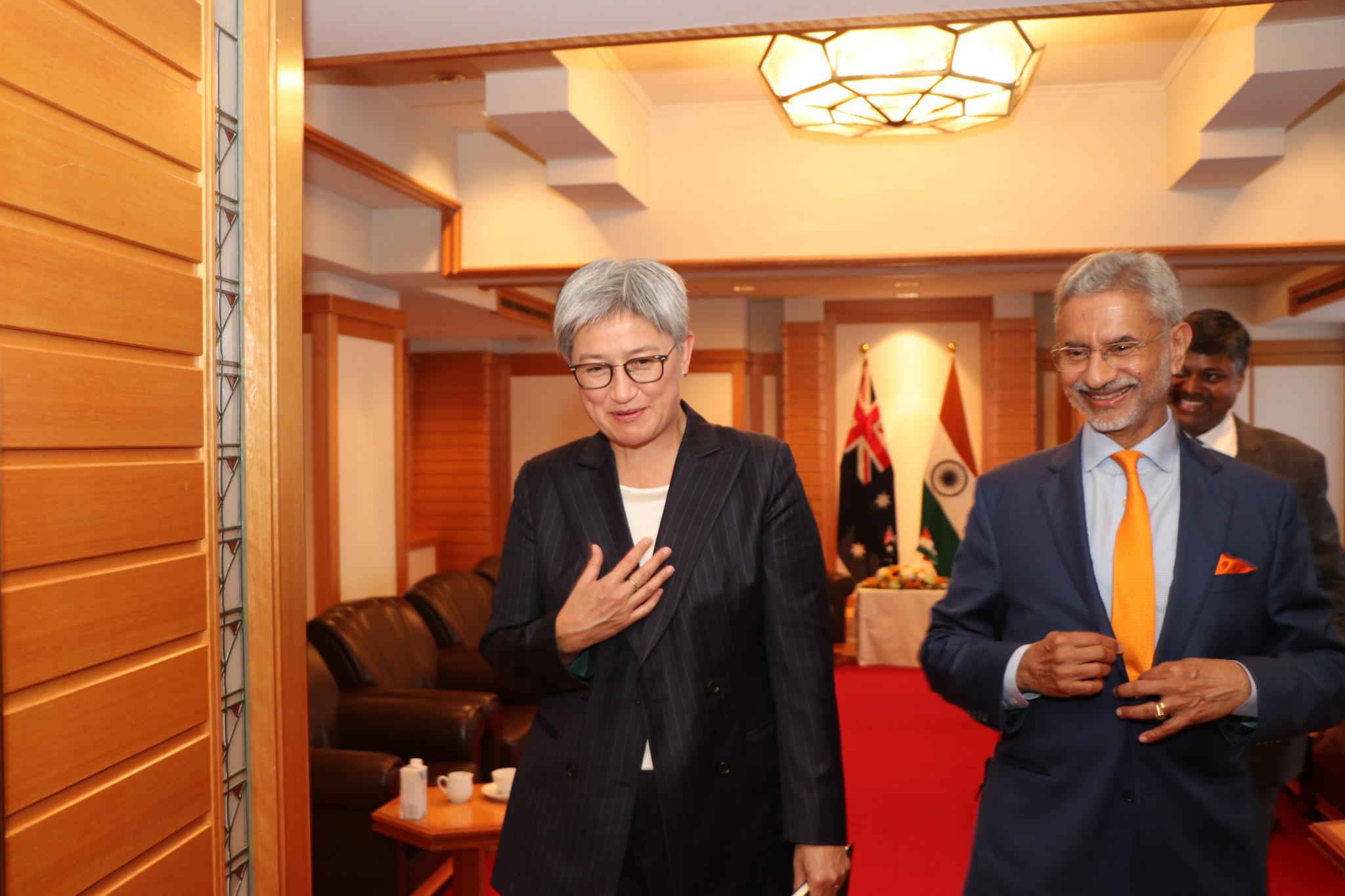
The July 2026 visit to Australia by Indian Prime Minister Narendra Modi marked a new high point bilaterally for Australia and India, a relationship that has made quite remarkable progress including in defence.
The leaders agreed a new joint declaration on defence and security cooperation covering the undertaking “to consult on defence-related developments in the Indo-Pacific that affect shared interests” as well as exercises, information sharing, aircraft deployments from each other’s territories, defence industry cooperation and dialogue on contingency planning.
Under the first Trump Administration and the Biden Administration, American policy was largely consistent with this kind of cross-bracing among allies and partners; a “latticework” as Biden officials termed it. In contrast, the second Trump Administration has had an unnerving effect: more intent on wielding economic leverage against allies and partners than on devising a shared geoeconomic strategy to curtail China.
This raises the question of how far Australia can genuinely go in projecting leadership—perhaps with a few other core partners such as Japan and India—to generate solidarity among Indo-Pacific partners, for how long and to what end.
The uncomfortable core question remains. What level of risk would these middle powers (or middle players, India and Japan being surely more than middle powers) take on each other’s behalf in the absence of leadership or security guarantees from a more blatantly self-interested United States? Whatever the answer, their Indo-Pacific cross-bracing proceeds apace.
This article was first published in India's World on 12 August 2026.

Related content

15 Feb 2024
The National Security Podcast
An ocean of opportunities: why Australia should prioritise the Indian Ocean Region
In this episode, Darshana Baruah, David Brewster and Shafqat Munir join Rory Medcalf to discuss the strategic importance of the Indian Ocean to Australia and the region.