
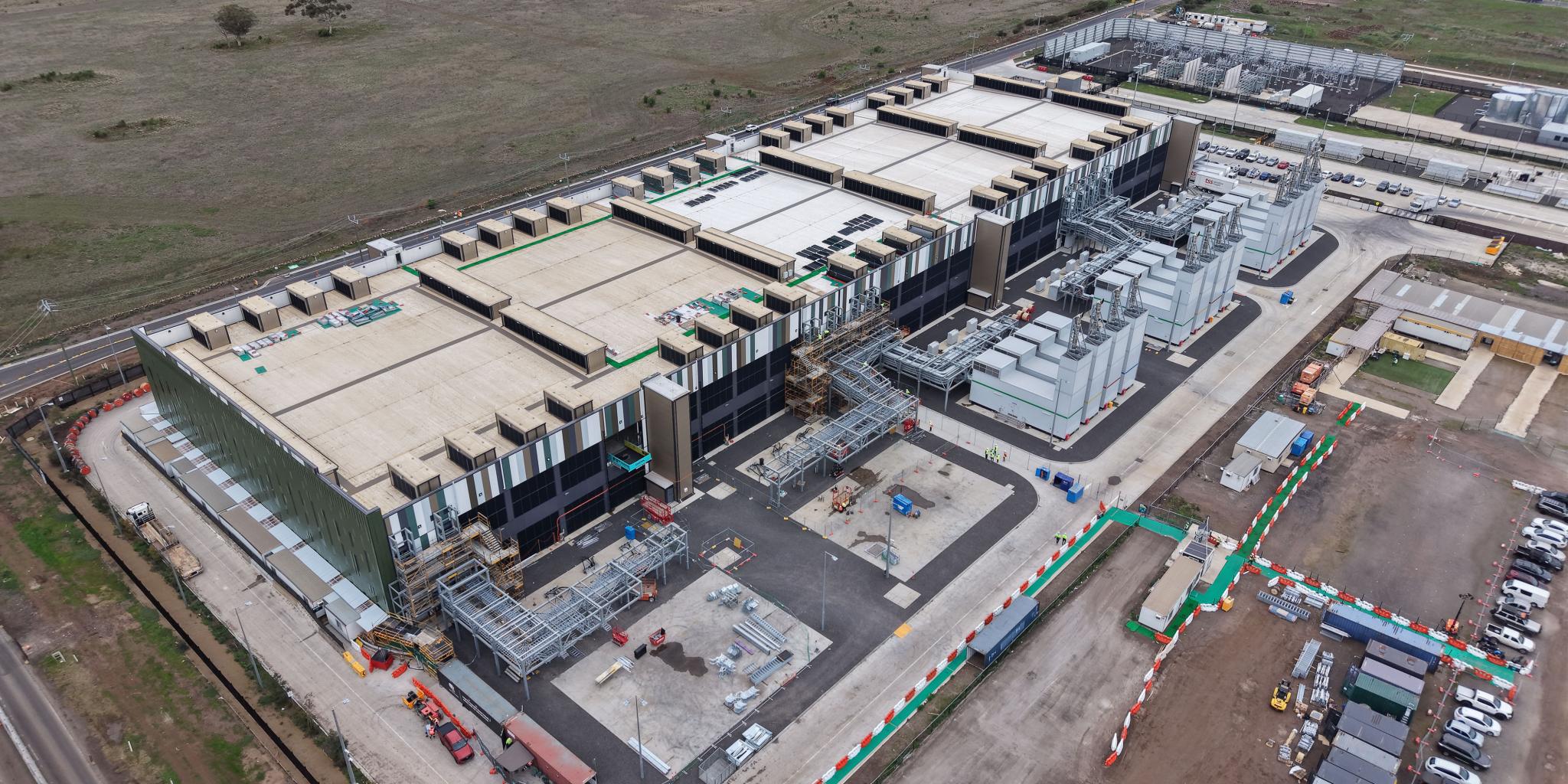
How thirsty is AI? Competing for Australia's most strategic resource
Transcript
Can Australia reframe water as a national security issue, rather than only an environmental or social policy concern?
What happens when drought, climate change, food insecurity, ageing infrastructure and economic pressure combine?
Can Australia realistically pursue both AI leadership and sustainable water management?
Who should be at the table for a national water strategy?
In this episode, Sharryn Parker speaks with Jason Alexandra and Matthew Coulton about Australia's water future, exploring why water security needs to be understood as a national security issue.
Transcript
(This transcript is AI-generated and may contain inaccuracies.)
Matthew Coulton
I don't think we'll have a circuit break until we have another drought and things fall apart.
Jason Alexandra
We've got to get out of the narrow water policy into this much broader. How does water work in the landscape? How does it work in society?
National Security Podcast
You're listening to the National Security Podcast, the show that brings you expert analysis, insights, and opinion on the national security challenges facing Australia and the Indo-Pacific, produced by the ANU National Security College.
Sharryn Parker
Welcome to the National Security Podcast. I'm your host, Sharryn Parker. It is my privilege to acknowledge the Ngunnawal and Nambri people who are the traditional custodians of the Canberra land on which we record. Australia is the driest inhabited continent on the planet. 70% is arid or semi-arid. The loss of our water is an existential threat. It grows our food, it powers our industries, our communities are sustained by our river ecosystems and increasingly, it supports our digital economy. Water is not simply an environmental issue. It is strategic infrastructure, it is an economic issue, and it is, therefore, an issue of national security. Our political leadership has seen state and federal water ministers naming data centers as an emerging threat to our water supply. In response, a Senate inquiry is investigating the validity of these claims. And from the top, Prime Minister Albanese has announced that he will introduce a world-leading artificial intelligence framework that includes new data centre rules on water use.
Now it's a start, but in the meantime, 40% of Australia's agricultural output is generated by the Murray-Darling Basin, and it's getting hotter, drier, and more volatile. The basin is so big it covers New South Wales, Victoria, and pushes into Queensland and South Australia. It's so complex that parts of it can be in drought while other parts are in flood, and yet despite its strategic importance, the question of water security remains largely absent from our national security debate. So today we ask, can Australia remain resilient, prosperous and strategically secure if it loses control of its water future?
I'm joined by Dr Jason Alexandra from the Australian National University. He's also been a consultant and a senior government executive. His work considers Australia's long-term water security challenges and the Murray-Darling Basin reform. I'm also joined by Matthew Coulton from WSP in Australia, and he is a recognized leader in climate risk, water policy, and strategic planning. He's formerly of the Bureau of Meteorology and he has advised federal and New South Wales governments on water policy and reform. Welcome to you both.
Both
Hello.
Thank you for having me.
Sharryn Parker
So water is a national security issue. Are we in a position where we can actually reframe this topic from a social or an environmental one and have a conversation about what it means from a national security purpose? Perhaps I can ask you first, Matthew.
Matthew Coulton
I think we have to reframe water to be more than a water policy issue and I know that sounds a bit funny to say, but many of the challenges that we've grappled with for many years in the realm of water policy have gone unsolved because they can't be solved within one area of government. So, you mentioned, for example, you know, agriculture is by far the biggest user of water in Australia. Yet we don't have clear connectivity between our agriculture and our water policy. So, you know, we have a food security green paper, I think, in Australia, didn't mention water security to me, which is which is a bit baffling. I think they've gone a long way to address it, but the Murray Darling Basin Authority got some criticism in the first version of that discussion paper they didn't mention agriculture. So, these are just sort of two examples of where we're seeing perhaps good policy done in a policy realm, but not cross-cutting. Similarly, I think one of the reasons that we don't consider water at that integrated national level is that we just assume, whether explicitly or implicitly, that there will always be water available. At the bulk scale in regional areas, we've done a pretty good job, probably better than anywhere in the in the world, about being able to have flexible demand that aligns with our very variable climate.
And there's issues associated with that, and those issues, for example, you know, in the basin plan about how things work when we see unprecedented climate conditions. But largely we assume that our cities and towns will always have water. So, we don't really imagine a world where those things are at risk. What we've learnt about climate variability and change, both from looking backwards to pre-European settlement and looking forward using climate data shows that Australia's climate is way more variable than what we previously thought and there may be scenarios that are just well outside those that we've seen before that would be enough to put some of those assumptions at risk where we might see issues where cities and towns are highly constrained. And we don't really like talking about it because it sounds scary. But unless we can look at that from a risk lens, then we can't really have mature conversations about the trade-offs. Between making different decisions. Cause the thing with water is there's no free decisions. You can err on the side of having more security and, but you know, you'll have economic and social impacts to doing that. But we need that cross cutting, cross disciplinary frameworks for having those discussions about water across all aspects of government and society.
Sharryn Parker
Yeah. Matthew, that's quite the opener. Can I can I throw to you, Jason? Do you think that water rarely appearing not just in you know our thoughts around national security, but in other areas and its assumption of it always being present and available? Is it a deliberate choice or is it something that we need to turn and face more directly?
Jason Alexandra
I think it's very much what Matthew said, there's just this expectation, it's sort of part of the normal conditions or the background. It's almost like we've been lulled into a view that governments have been able to provide cheap and abundant water, whether it's to cities or irrigation. And the climate historic climate variability that's over the last five thousand years and the projection forward mean that we should get ready for much greater extremes, sequences of weather that make what we've been able to measure in the last hundred, and twenty years look like it we've had a pretty good run. And so when we're in the middle of a big drought, we don't know whether the drought's going to break within a couple of months or within a couple of years or within a couple of decades. And so a drought sequence isn't like other forms of disasters, which are kind of one-off events.
They’re slow, they're grueling, and they test governments out, they test communities out, they place a lot of stress. And just to give an example, which perhaps many of us thought we'd never see, they're shutting down a nuclear reactor in Hungary right now because the Danube is so low that there's not enough water to cool it. They'll be in heat wave conditions. They won't have enough electricity to cool down cities. And we have seen these extreme events where heat related deaths go up. So if we just look at water as water as a kind of commodity or a resource, we miss the fact that it's become a critical input to a whole range of modern technologies, the whole way we live in modern societies with these deep connections to food security, water security and spin off from that to geopolitical security. So it was fashionable during the Millennium Drought to talk about water security in Australia, but we haven't really taken that experience, that pressure of decade-long drought and said, what does it mean to really deal with water as a central issue to our national security? So, the best example is the Millennium Drought, where it tested out all our irrigation-based industries, the mouth of the Murray has remained closed throughout most years of the twenty first century. It only closed once in the one year in the eighty-three drought. And so, we have these we could call them compound risk factors or cascading risk factors so we've established major dependencies on irrigation. And then we get a climate variability that's really not that extreme as in there was similar droughts in the Federation and the Second World War, but the economic dependencies gone up. We also saw virtually every major city in Australia, well every state government make major investment decisions towards desalination plants and augmenting urban water supplies. There'd been population growth and there'd been an expectation that demand management could secure urban water supplies, and then a drought of historic proportions came along and suddenly there was this urgent rush to build D cell plants and literally at great expense to the urban ratepayers who will be paying for those D cell plants for decades, maybe even generations. So getting what we might call sensible or appropriate water policy is about having some realistic or perhaps realistic feasible views of what scenarios we might be facing, how important the social and economic dependencies and then what kind of investment in water supply, water provision really makes sense. And these are not, you know, they're not trivial decisions, even with a stationary climate, when we put them in the context of a changing climate that is shifting that future risk profile in ways that are very hard to predict. All we know is that they're likely to be much greater. Then we need to really use the best brains in the country to think about how to do it without jumping into the risk of what's called gold plating. So, we want to make sure that we don't have massive over investments to over secure water, because that then is dragging investment from other important public policy issues.
Sharryn Parker
So it sounds like that there's a number of different things we actually need to consider. Matthew, w you know, if we consider the idea of compound shocks and then tie that together with the potential risk of gold-plating solutions, you know, how would you go about actually dealing with all of those?
Matthew Coulton
Look, I think I think it's a very multifaceted question with many different solutions. I think one is a probably a look at how we regulate water pricing in Australia. So we again, you know, Australia is world leading in a lot of the ways that we manage water. And in theory, we have independent regulation of water pricing. But you know, following the millennium drought and the scene that Jason said, we had in many Australian capital cities over the 10 years that followed periods where water rates went down or remained static and we had plenty of water around. And it wasn't that that was the fault of the regulator or the fault of the utility or the fault of the governor of the day, but in the lack of a pressing imminent need to invest more in water, it was convenient for everyone not to do so.
So in Sydney, you know, where I live now, I think there was three years in a row where water bills went backwards, and it was the front page of the paper and everyone was happy. Obviously, the minister of the day was happy. The utility was happy to go and tell their customers. The regulator said, you know, we've actually reapproved a reduction in bills. Yet here we are, you know, just not too many years later. And we have utilities that are submitting price submissions saying they need to double their rates in the space of four years and that we have, you know, infrastructure that's 50 years old and needs replacing and that we need to build more desalination and more recycling. And it raises the question for me of, well, you know, none of this stuff has come as a surprise in in all those good times. Why were we flattening and suppressing investment in water and now we have a bit of a cliff? So, I think although we do have independent price regulation in principle, I think what reality shows is that it's still subject to short-term political pressure where, you know, if we don't need to spend money now, we would prefer to put it off. And I agree with Jason, we also want to avoid overspending at a point in time and gold plating, because that has long-term costs. But we also need to consider the long-term costs of providing water, not just the short term. And It’s probably not the place to go into it now, but throughout the past, when we had our big dam building era and we built a lot of water infrastructure. That was paid for by governments from consolidated revenue. So we've never really paid for it. People have never really paid for environmental services that have come from water. Water has largely been free. And now we're in a world where those infrastructure needs renewal. We need new infrastructure. And we live in a world where it's expected that people pay for environmental services. And all of these compound costs are coming at once. And in the time of a cost of living crisis and governments saying, look, we really would rather you don't put up bills. So I think there is a big question there in in pricing, as well as strategic planning and other things that are inherent in water, but pricing has been a very strong tool and a very strong signal in Australia around water scarcity and long-term security. And I think we should revisit it.
Jason Alexandra
Matthew mentioned that the environmental services of healthy rivers have been free and not accounted for. And so we've degraded many of our river systems, wetlands, estuaries, et cetera, without paying for them. Now, if we look at calculations on how to restore them, even if it's technically feasible, you know, it's astronomical. So we've got to think of water in the landscape, not just as water in the pipes and the dams, as part of our natural resources or natural endowment that needs looking after. So your first question, you know, what kind of policy? We've got to get out of the narrow water policy into this much broader, how does water work in the landscape? How does it work in society? That means water policy issues central to things like treasuries. You know, we just talked about investment, economic investment, infrastructure, social equity, and a whole bunch of other things. So I mean it needs this holistic view of it and it also needs the long-term strategic view where, you know, we don't move from the what we know we live in a climate of drought and flooding rains, and that we don't just react each time when there's been floods. quick, we've got to do a lot about flooding. When we’re in drought, we've got to do a lot about water supply. We almost need to be counter-cyclical in our investments and go, right.
During those drought phases, that's the time to be thinking about are we getting ready for the flood? And during the flood phases, it's like, how do we manage all this surplus water so we're gonna be ready for the next drought phase? With a kind of anticipatory approach, which says, as I said before, we don't know when we're gonna swing from one phase to the next, but we do know that's how this continent works.
Sharryn Parker
So, I just want to you know, focus on this idea of having a lack of pressing need and then waiting for the signal to then react. Matthew, you spoke about the technical feasibility and then Jason, you mentioned the astronomic cost. I guess with a subject like water, which is existential, you know, without it there is no life. What kind of price are we willing to actually pay in order to get that counterintuitive feed into our national way of thinking?
Matthew Coulton
I think water is tremendously undervalued and probably contrary to popular opinion in an urban context at least underpriced. So, in Australia, for example, let's just exclude bulk water and agriculture and rivers in cities. The vast majority of water that we use in cities in households doesn't go to drinking or even hygiene, most water use in urban areas in households go to backyards and gardens and swimming pools and things like that. Now that's fine, but to me there is a bit of a conundrum there when it goes to reviewing water pricing and lots of governments in recent reviews have sort of said to their regulators, we really don't want to put up water prices. We're in a cost-of-living crisis. The price the cost of charging a bit more for water for someone on a lower income who lives in, say, an apartment without a backyard is very, very marginal compared to the household bill, compared to energy, compared to groceries, compared to everything else that is important for human life. Yet we still seem to have a political, real aversion to the idea of charging more for water, despite, as you say, being the most critical enabler of all of society and all of e of economies. So I know it's not a very popular answer, but actually properly valuing water and charging for the full long run costs of that order, including the environmental services that Jason talks about, would at least better recognize and provide a better signal of scarcity and value.
Sharryn Parker
Do you think we're gonna see anything different, Jason, when we actually start producing these data centres that then sink up to twenty percent of the water supply that's available to us?
Jason Alexandra
You know, I'm years ago I was referred to by irrigators as the free-market ecologist and my answer to that question is don't single out data centres. There's lots of industry that uses lots of water. And if we have the policy architecture right and make it a competitive environment, you know, we don't say industry X can't buy land or can't use electricity. So I I'm just a believer in treating all enterprises equally in terms of a regulatory environment and let them compete for resources and if they if we need to supplement water supply because of somebody building a massive data centre, make them pay the real cost of that supplementary supply. But as Matthew said earlier, we know that about 70% of all water used in Australia is used for agriculture, for irrigated agriculture. A lot of it's still relatively inefficient from an economic perspective. It might be very inefficient. And we have committed to water markets which allow the transfer of water rights around. So, if urban area, you know, if an urban area is competing for a data centre, you know, maybe buy some irrigation water rights and use that to supplement supply.
So, I think they're kind of the latest thing that we love to hate, you know, and I've had the same view expressed to me about cotton farms or sugar farms or whatever it is. It's like, let's not pick on the commodity or the service or the enterprise. Let's actually put serious capability into making sure we have the policy architecture which deals with, you know, the social justice, the equity, the efficiency side of the way we go about setting up setting up our water policy, our water policy framework. And Australia's had several goes at reforming water policy. They have some international significance in terms of being an attempt at a coherent sort of modern policy architecture for water but it's like the job's incomplete. So let's keep a commitment to you know, you asked the question, Sharon, about what price should we pay. Actually, we should invest in the best minds in the country to critique how well we're going and how we're dealing with things like climate risk and so forth, and then use kind of surgical policy reforms rather than this polarizing the some bad water using industry out there or there's some desperately important environment. Let's treat it that the whole continent is, you know, socially, like culturally rich due to the indigenous involvement and in custodianship of this landscape. Water's a central part of that. Wherever you go, there's critically important water sources or water flows. And we need to be thinking about what kind of as a nation, what's our relationship with the water on this continent?
Matthew Coulton
Yeah, I think just to add to that, I think quickly on the data centre issue. I don't mean this in a in a very critical way, but I think some of the attention around data centers is a product of people rushing into a problem that we actually know how to solve. We have institutions and governance in place that can manage that and I think if it's managed right. We could actually see a bit of an acceleration of investment and regulation that we should have been doing anyway. So say for example, water recycling in Australia, which to a water scientist like me just makes eminent sense because I know that all water was recycled anyway, has long been on the go slow in Australia, not for technical reasons, but for political reasons, where it has been attempted in a few places, there's been very political, strong political campaigns against it. And so we've kind of been scared of it. If we can see the shock of data centres coming into an urban context leading to an acceleration of bringing more recycled and other climate resilient sources of water onto the grid. And as long as those data centres pay the full long run cost of a high security water product, then I don't think it's as scary as it's made out. I think just to put some numbers around what Jason was saying. Some of the upper projections of data centre water demand in Australia looking about 17 gigalitres by 2030. We have some individual farms in Australia that use more than that water in a year. And it's not a like for like comparison because we don't have a farm in the middle of a city, you know, taking out water and having to use it every year and it's not treated water. But just to put the numbers in context, it's perhaps not what people would think based on what we've seen in the media. I did just want to get to that point around seeing it as a cross-cutting issue and having strong minds that perhaps look beyond the political cycle. If you see countries that have done water security and water management policy really well, they have managed to create institutions that are somewhat resilient to short-termism and politics. The Dutch are very, very good, very, very good at this. They have a very robust, strong water policy architecture that doesn't get touched or meddled with too much by politics.
In Australia, back when we had a National Water Commission, and I'm not necessarily advocating for re-establishing one because there were some good reasons why Australia's was ceased. The National Water Commission in Australia reported to the Department of Prime Minister and Cabinet. They didn't report to the Water Department. Of course, water reform in 2007 and the years that that followed was seen as this big cross cutting issue. And so you had a National Water Commission that was a partly unpopular because it was doing what Jason said and it was reporting on, you know, whether the state and territory governments were doing a good job or not.
Now, fast forward, we have the Productivity Commission is in charge with reviewing national water reform every three years. And the last three reports have largely been noted by government. So the Productivity Commission has come out and said, look, we've made progress in some senses in others we've haven't and then government said, okay and then three years later, the Productivity Commission comes out and says the same thing and governments say, okay. And we're nearly about the fourth cycle of that happening, which shows that from a governance sense, there is a need for some sort of circuit breaker. And I don't blame necessarily the individual water policy departments for this because they just don't have the authorizing environment to deal with water as a cross-cutting issue. You know, the environment departments that are charged with water are consider relatively junior portfolios from a political perspective. They have very small budgets. A minister doesn't really get rewarded for doing stuff in in water because people just expect water to come out of the tap. They can lose some political skin if things go wrong.
Dr Jason Alexandra
Another important dimension of that is the whole federation relationship. So, you know, water is primarily a state responsibility, although the Commonwealth's got increasingly involved. It's also very much a local utilities responsibility. And so we've got to make the federation work from top to bottom if we're going to get water to work. And so the architecture, the reform architecture was about involving prime ministers and premiers so that it did have that cooperative federalism sort of wraparound. And on the productivity commission, I was quoting a colleague of mine and I have produced a climate we're calling it an adaptation action agenda for Australia. I think it's five A's in a row. And I quoted from one of those Productivity Commission reports, I think it might have been the first one, where it said Australian water agencies lack the capability for dealing with climate change and climate risks and it's time that there was a sort of significant upscaling in their capabilities for dealing with climate risk or something like that. And that's six or seven years old. And there's been no big national commitment to deal with that need. So yeah, it's important to get beyond the report being landed and start acting on some of these insights.
National Security Podcast
We'll be right back.
In this disrupted world, Australia needs security professionals more than ever. Join the next generation studying at the ANU National Security College. Our programs uniquely fuse academic knowledge with practitioner experience and fit around your lifestyle with study offered online and on campus. Follow the link in the show notes for more information about programs and scholarships. The ANU National Security College.
Engaging minds for a secure Australia.
Sharryn Parker
So in our rush to solve the problems that we can fix, Matthew, you mentioned a circuit breaker. What do you think that might actually look like now?
Matthew Coulton
I don't think we have a circuit break until we have another drought and things fall apart. I think something that has surprised me, you know, Jason's example of a shock was a millennium drought. I probably have a bias here because I'm from northern New South Wales where the millennium drought wasn't as severe. The shock for me was the tinderbox drought. In New South Wales, nearly fifty towns ran out of water. The country was on fire in the late two thousand and nineteen and in early 2020 it rained, and there was nothing scientific or technical about that outcome. It was luck. And I've probably had a few tough arguments with some climate science friends. I think we actually overinvest in modelling and forecasting and trying to deal with uncertainty this way. I just go back and say, let's have let's have the tinderbox drought from 2017 to 20. And imagine if the drought didn't break for another six months.
Like in that time period you're not just looking at Sydney in being a very precarious place, but regional cities like Dubbo and Tamworth, where you couldn't just, you know, evacuate people even if you had to. I thought perhaps that that would be the shock, you know, to reinvigorate and have a national focus. And perhaps it would have been not for the bushfires. A lot of the response then came to the bushfires. We had a bushfire oil commission, and it drew a lot of attention to a lot of important issues around emergency management. But we didn't really have the same conversation about water. So again, there are some really good initiatives going on to try to improve some of the institutional arrangements that were shown to be insufficient in the tinderbox drought, but they're happening again at the departmental level of water policy departments who, in my experience, are very passionate people. They have capability, but they don't have the authorizing environment to solve problems that transcend governments, you know, to Jason's point, local, state and federal and portfolios. So, they're kind of hamstrung from day one by trying to solve a big problem through the lens of, you know, in environment largely.
Sharryn Parker
Jason, can we get ahead institutionally of the next shock?
Dr Jason Alexandra
Yeah, of course we can. We can do it in multiple ways. And I guess working in a university now, I think about it in terms of how we equip the next generation of decision makers. And so we've just run an intensive course, a master class, we're calling it first time at the ANU. It was a week-long intensive called The Next Big Dry. The whole idea was it was immersive scenario-based learning. And over that week the scenario that we it was role play that we put the participants into. The drought actually got worse over the next 15-year period. And every attempt at responding to the worsening conditions got, you know, failed to have much impact. And so we were really putting them in something of a pressure cooker environment and saying, you know, you are now in a decision-making role. The country is in the grips of a deep drought and things are getting worse and it's generating a kind of chaotic as it went on, it got more chaotic. And part of that was intended, it was designed to put people who work in water agencies, water policy agencies, utilities, in a kind of rehearsal mode, so that they're starting to think, how do we how do we proceed when things aren't going according to plan? And I believe that kind of capability, you know, the scenario will never be accurate but getting people to engage in this idea that look, things can go bad and they can go worse than bad. You know that we tend to have a fairly narrow view of what the expected future will be and how to sustain order in whatever field we work in.
This comes back to your first question around security. I mean, security in a part is to do with the institutions in society able to maintain order. And a big part of people's expectation is that things like the networked infrastructure, electricity, communications, water, and transport work. What happens when those things start breaking down? You get not just the material consequences, you get a lot of social consequences. And so with that was the sort of how we were engaging the decision makers, the future decision makers in this scenario. And you know, like all sort of experimental learning approaches, we weren't sure how the process would work. But at the end of it, and based on the feedback, we're very keen to continue this kind of work as a way of building that capability.
Sharryn Parker
Matthew, on your side of industry, you know, this idea of a tabletop exercise or a master class that that actually puts people in a high-pressure environment where decisions are required to be made, gets the blood up, et cetera, rehearsal modes seems to be working pretty well academically. But on your side in industry, can you can you offer that? Is there somewhere else that does that as well?
Matthew Coulton
There's really good examples of where organisations do that. But and, you know, from my job at BOM, you know, BOM used to do a lot of that type of thing with emergency managers. I think the challenge is getting the right participants in the room. So you know, the people that I think would need to be involved in this, you know. Senior officials in treasury and central agencies, you know, premiers in cabinet and prime minister & cabinet, because at the of the day when the event actually happens, you know, they're the ones that are going to be called upon. And in water, we have a real problem in that by the time you are starting to see evidence and observing that you're slipping into a drought or into a crisis, the options you have to respond to it are nearly all gone. So, you know, Jason's example around desal plants. So, you know, in Sydney in the tinderbox drought, I think went from dams virtually full to forty percent in the space of two years.
Now, if the drought went on for another two years, no one can convince me you can do a desal plant in Sydney in two years. It'd be interesting to see if we could, if we had to, but I've not seen any evidence that that that's the case. So we kind of need to have those sort of scenarios played out, but across institutions, across levels of government, and with people that aren't always engaged in what's happening in water. I guess just a an anecdote to give a scenario of the types of situations that we ended up in in 1920. I was in a meeting in the spring of 2019 at the New South Wales Rural Fire Service headquarters and we were role-playing a very, very real scenario that did happen, as if a town in New South Wales was at risk of being burnt down, and the only water the fire service had access to was the remaining drinking water for that town, should they take it or not? And I was remember sitting there thinking, how did we get to this point? So having the fire brigade have a choice whether to take the last drinking water from the town, which would essentially mean the town would have to be evacuated in order to put the fire out or to let the fire the town burn down. I mean, that's the type of scenario I'd like to put some people in ahead of time. So perhaps we could precipitate some thinking about how we avoid it.
Sharryn Parker
Yeah, we're reframing what existential actually means when we ask those questions. You know, Jason, who would be at the table, you know, for a national water strategy and follow-on exercises if you're in charge?
Dr Jason Alexandra
I would probably pick up on what Matthew said, make sure we had the adequate representatives from state and federal governments from Premier and Cabinet and or Prime Minister and Cabinet type central agencies. Some of the Treasury people, because we've already we started off talking about investment and the economics of long-term investment and water. But I would also suggest that some kind of a brains trust or a bunch of independent advisors, however you configure it, so that there's enough, I'll call it sort of friction to catalyse some honest appraisal of the situation. So, you know, it's part of the tendency in hierarchical organizations is that when the boss says black is white, everybody says black is white. And we have to be careful of the group think and also in Australia, there's a tendency be triumphalist and say, we've got the best water policy in the world, or we've got the best, you know, we've managed the most variable climate. And it if you know anything about what's going on around the world, it actually doesn't stack up. But it's also quite damaging because instead of going, look, Australia's a good place to learn about water problems and how to deal with them, because we've made so many mistakes and we're still learning. It's a much humbler, humbler way to approach it.
So how to get people are in very powerful and influential positions to face up to the fact that we've still got a hell of a lot of work to do and there's a big room for improvement. And so somehow getting away from the standard hierarchical structures, I think, is a necessary part. So, you know, whether it's through some kind of a commission or commissioners or bigger investment in water research and kind of public debate about where we're going, I'm not sure. But, you know, open it up, I guess, is what I'm saying. And big bigger sort of discursive dialogue around what's needed.
Sharryn Parker
I love the idea that, you know, as both of you were putting forward your view on who should be at the table if we, you know, undertake an exercise on how we actually deal with these strategic issues of national importance. And both of you were running through, you know, prime minister and cabinet obviously lands at the table with various other agencies around treasury and finance, et cetera, but nobody has actually said the Department of Climate Change, Energy, Environment and Water.
I guess we take it as a as a given that of course they are part of that that brains trust, but thinking about it more deeply actually requires some much bigger and differently moving levers, which is really fascinating. Look, gents, thank you very much for answering some of my questions today. I guess I have one final question for both of you. Matthew, can I ask you first if you could change one thing about how Australia governs its water security for the next twelve months, what would it be?
Matthew Coulton
I'm a bit of a simplist. I don't know if that's a word when it comes to governance, but I'm a real believer in clear accountability. And because we have different aspects of water distributed across different areas, by design, in some areas we we don't have clear accountability for a problem. And you see when we have crises, so whether it was COVID or whether it was the bushfires.
Governments are actually really good at standing up points of accountability for dealing across different areas. And we all of a sudden get efficient more efficient decisions made. Look at the kind of decisions governments made during COVID at a drop of a hat. So I would say with governance, I do think we need a role. And I don't know if it's individuals or if it's an institution or if it's, you know, to use Jason's words, commissioners, but we need people empowered, even if they're not empowered to make the decisions, but to fully describe the problem and call for the decisions to be made, that that sit outside the individual portfolios of environment and climate change and agriculture, outside of the utilities, you know, say in the urban context, one of the challenges we have is accountability for water security is kind of distributed where I live in Sydney, across the department who runs the greater Sydney water strategy across Sydney Water, who provides retail water services across Water New South Wales, who runs bulk water services, across IPart, which does the regulation of pricing. And there are some good design reasons for that distributed accountability. But as a result, there's no one person who's in charge of saying, is Sydney prepared to deal with the next drought? And I think there is a role, there is an there is a needed role for someone or a voice that sits outside of the each of those different entities who can speak truth to water security issues and potential solutions.
Sharryn Parker
Fantastic. Jason, for you a final word. You know, the Institute of Water Futures here at ANU, that masterclass that you mentioned earlier, uses the framing from critical thinking to critical doing. So what does that actually look like for water security at the national level, according to Jason Alexandra?
Jason Alexandra
I think I'm in heated agreement with Matthew that if we look at big complex processes of government around essential services, we need to get the institutional architecture right. And when there's these situations where there's lots of agencies involved but nobody is ultimately accountable, it's too easy for the problem. You know, the Australian Federation has a lot of blame shifting built into it already. And we need to think about designing a b bespoke design for that institutional architecture and make sure that the accountabilities, that is, you've got to serve somebody and somebody's always got oversight, but you shouldn't have people marking their own homework. And so build that accountability, build the architecture. And I have to say, I'm a big fan of this idea that we need to reinstate a new National Water Commission.
But it should be called the National Water and Climate Adaptation Commission, because so many of our adaptation problems are centred around water, and really have some strong convening powers and some, as Matthew said, describing the problem, start really generating the debate about what we should be doing about it. And also get some good sort of how do we deal with, you know, if this El Nino is the beginning of the next big drought, how well prepared are we?
And so that kind of sort of generative moving from just thinking this might be a problem to, let's get ready for it. Let's anticipate, let's hope it doesn't get as bad as it might, but let's be ready for it well in advance. It seems to me that's got quite strong analogies to the military strategies where you hear old generals say, you know, we always had to be ready, but we hope we never had to go to war.
And I think it's the same sort of thing. You know, we need to be ready and we need to be acutely aware of that we could be taking some really bad decisions in terms of maladaptation. So how do we scrutinize those big decisions that you can't turn back on? You know, building another dam or a D cell plant, basically it's sunk investment. So let's get that the framework for making those decisions right.
Sharryn Parker
Love it. The you know, the idea of the the old military be prepared to fight tonight, but plan for the future. Absolutely expands beyond the military mindset. I think it works for certainly our our water security in the future as well. Gentlemen, thank you very much for joining me here today.
Matthew Coulton
Thanks having me.
Jason Alexandra
Thank you. Look forward to a future discussion.
National Security Podcast
Thank you for listening to the National Security Podcast. We welcome listener feedback and suggestions at any time. So please get in contact at natsecpod at anu.edu.au. For more important conversations about Australia's national security, please subscribe to the podcast, our YouTube channel, and follow us on LinkedIn and Twitter to receive the latest updates.